Lululemon Invests $30 Million in Nylon Recycling Innovator Syntetica’s Series A Funding Round

Lululemon, a company known for its activewear, has contributed to a $30 million Series A funding round for Syntetica, a French startup pioneering a unique method for recycling nylon, a material that, despite its valuable qualities, poses challenges for reuse.
Syntetica aims to recycle two forms of nylon—Nylon 6 and Nylon 6,6—which are difficult to differentiate in the textile waste collected from consumers, as explained by CEO Marco Bertone.
With massive quantities of clothing ending up in landfills annually, the fashion industry’s shift toward circularity is partly driven by consumer expectations, especially among premium brands. Syntetica also stands to gain from favorable regulations and recent fluctuations in nylon prices.
Bertone noted that geopolitical issues in the oil sector have resulted in frequent changes to nylon pricing. “Many brands that depended on petroleum-based nylon are experiencing significant disruptions,” he remarked.
This situation aligns well with Syntetica’s practical outlook. “We’ve built the company with the understanding that sustainability must be cost-effective and scalable, along with forming partnerships right from the outset,” he stated.
Syntetica collaborates with brands such as Lululemon, Victoria’s Secret, and Etam, planning to roll out a recycling initiative by early next year. The company’s funding round also attracted attention from MAS Holdings, a notable apparel manufacturer, who recognized the scale of the recycling challenge.
It is rare for a supply chain entity to invest in a startup at an early stage, but prior to its Series A, Syntetica formed an alliance with Michelin’s Centre for Sustainable Materials to build a commercial demo facility in Clermont-Ferrand, France.
Distinct from its peers, Syntetica will not create textiles or new materials but will produce pellets from its recycling process. These pellets can be utilized by other manufacturers to create yarn, as exemplified by MAS. “Our approach emphasizes pragmatic industrial collaborations to secure commitment from the entire supply chain,” Bertone shared.
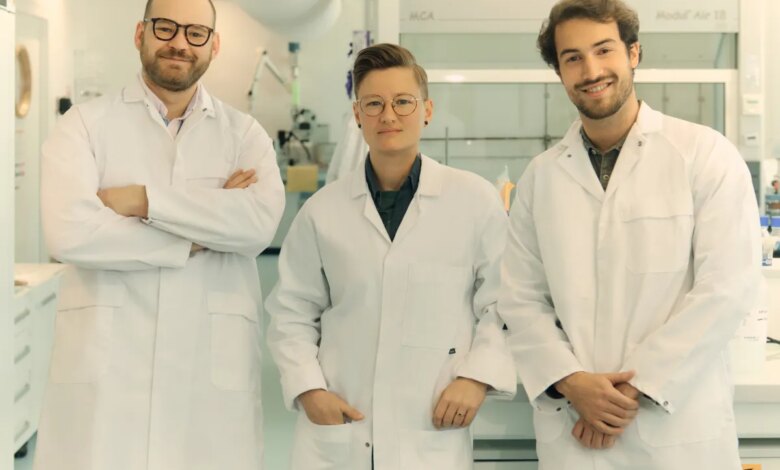
Bertone, with a background in fashion and second-hand e-commerce, plays a key role in the company. He partnered with chemistry researcher Louis Monsigny through Entrepreneur First’s accelerator at Station F in Paris, solidifying their collaboration in Reims at AgroParisTech’s laboratory.
Since then, they have expanded their team to include CTO Ash Ward, who has previous experience with the now-defunct battery company Northvolt. According to Bertone, the team’s collective experiences bring valuable insights into managing the complexities of growth.
“Startups must embrace higher risks than established industries to innovate. However, there’s a balance—taking on too many risks simultaneously can lead to complications,” he explained, noting that Syntetica isn’t diversifying just yet.
Although there are plans to eventually recycle other materials or branch into different sectors, the primary goal is to showcase the capacity to produce hundreds of tons of pellets annually and supply them to the apparel industry. Following that, Bertone envisions Syntetica establishing facilities worldwide, near sources of waste and textile production.
While the startup has global ambitions, its French base offers strategic advantages. The Series A funding was spearheaded by the Ecotechnologies 2 fund, managed by the Green Venture team at Bpifrance, as part of the France 2030 initiative. Additionally, Syntetica received backing from the European Innovation Council through equity and grants.
For public investors, startups like Syntetica represent efforts to bolster Europe’s industrial capabilities while decreasing dependence on fossil fuels. The startup is also pursuing profit and has attracted private investment from firms like EQT Ventures and SWEN Capital Partners.
Syntetica faces competition, including other companies employing enzymatic recycling methods and chemical giants like BASF, which has developed a recycled nylon product. However, Bertone remains optimistic about the industry’s potential. “If all players scale up to multiple factories, we still won’t resolve the issue alone,” he stated. “Our success as a society relies on everyone’s achievements.”
In addition to Syntetica, Lululemon has also invested in other textile recycling startups such as Epoch Biodesign and Samsara Eco.