A new bill allowing the operation of autonomous vehicles in Washington, D.C. presents a significant challenge for Uber’s strategy in the robotaxi market. Rather than merely collaborating with robotaxi developers, Uber aims to influence the legislative landscape, directly opposing its ally, Waymo.
Uber has voiced opposition to the bill, claiming it would effectively displace human drivers and benefit Waymo with a near-monopoly. The company instead advocates for a system mandating that robotaxis coexist with human-driven vehicles on ride-sharing platforms, based on information from public records and interviews with industry insiders.
“We’ve seen in other regions how a poor regulatory framework can disrupt urban environments,” stated Javi Correoso, Uber’s U.S. policy chief, during a D.C. Council meeting in May. He noted that robotaxis can contribute to congestion by idling or cruising without passengers, lack the kind of assistance human drivers provide to older or disabled individuals, and mentioned that one autonomous vehicle can replace several human jobs.
Discussing the hybrid model, Correoso articulated Uber’s regulatory goals.
“A hybrid model means consumers should have access to both options. If someone uses the app, they should be able to select,” he stated, as per publicly available documents. “Furthermore, I believe there should be a regulatory mandate requiring consumers to have the option of selecting a human driver.”
Waymo, which supports the bill, argues that it will enable the safe integration of autonomous vehicles while aiding public transport and ensuring fair access without limiting companies like Uber.
Both companies will present their arguments at a lengthy hearing scheduled for Monday. While the bill’s approval isn’t imminent, many stakeholders hope it will pass before the end of the year, especially before D.C. Mayor Muriel Bowser’s term concludes in January. The ongoing debates and lobbying surrounding the bill reflect a larger trend that extends well beyond D.C.
The Proposed Autonomous Vehicle Bill
Introduced by Councilmember Charles Allen in May, the bill seeks to amend the existing Autonomous Vehicle Act of 2012 to allow for driverless testing and commercial operations in the district. Currently, autonomous vehicle trials, conducted by companies like Waymo and Zoox, require a human driver to be behind the wheel.
The revised legislation would empower the District Department of Transportation (DDOT) to distribute permits for driverless operations and testing to autonomous vehicle developers that satisfy specific criteria. These include maintaining at least $5 million in liability insurance and providing crash data reports within specified timeframes.
Additionally, the bill proposes a $0.15 per mile tax on robotaxi operators, a point of contention for advocates, who argue it is excessive. Funds from this “vehicle miles traveled” (VMT) tax would be allocated with half going to public transit and the remainder to educational and workforce initiatives for human drivers potentially displaced by autonomous vehicles.
The bill has attracted interest from various parties, including Tesla, Lyft, the Teamsters, and advocacy groups focused on disability and accessibility issues, all scheduled to present their viewpoints at the hearing. An anti-robotaxi campaign initiated by a New York-based group, Coalition for Accountability and Road Safety, has also emerged, engaging voters and utilizing social media outreach.
Details about the funding for this campaign remain unclear, though it has ties to a New York lobbying firm associated with labor and employment advocacy. The stakes are notably high for all stakeholders involved in the robotaxi landscape, particularly Uber and Waymo, who hold considerable market shares. Uber is the largest ride-hailing network in the U.S., while Waymo operates a leading robotaxi service, delivering over 500,000 rides weekly across 11 cities.
If Uber secures adoption of its hybrid network in D.C. or elsewhere, it could compel autonomous vehicle developers like Waymo to either integrate their services with existing ride-hailing platforms or employ human drivers to accompany their robotaxis.
Conversely, if Waymo and its supporters win the legislative battle, Uber fears it could be sidelined entirely.
Seeking Protection and Growth
While this bill deals with local policy, it underscores Uber’s strategy to fortify its dominance in the ride-hailing and delivery sectors.
Uber is concurrently investing in and collaborating with over 30 autonomous vehicle technology companies worldwide while establishing AV Labs to gather and share real-world driving data with AV developers. Multiple job openings for engineers in this division indicate serious investment in this area.
As Uber positions itself within the AV market, it also champions policies that would require autonomous vehicles to operate alongside human drivers on a unified platform, similar to the Uber app.
Uber’s push for a hybrid network, which surfaced in a white paper earlier this year, is a recent development. The company has intensified its policy advocacy, particularly in discussions regarding updates to the district’s Vehicle-for-Hire Innovation Amendment Act. Although separate from the autonomous vehicle bill, the underlying policies are interconnected.
In June, Uber submitted a letter to the D.C. Council outlining its hybrid network vision, which suggests a gradual inclusion of autonomous vehicles within existing systems that still utilize traditional drivers.
In the context of the D.C. bill, Uber faces a proposal that could effectively eliminate hybrid networks. Waymo, however, challenges this interpretation, asserting that it supports flexible regulatory frameworks for diverse networks.
While Uber’s hybrid model is met with skepticism by some industry insiders, it’s noteworthy that numerous critiques have emerged regarding the D.C. bill and its provisions.
Greg Rogers, the founder of mobility think tank The Innovation Majority, plans to address the hearing, characterizing Uber’s hybrid push as an instance of “regulatory capture.”
“Market choices in mobility already exist—people can opt for buses, bikes, rideshares, or walking. Argumentation for specific business models at the expense of others might not enhance consumer choice or road safety and could simply reinforce existing interests,” Rogers asserted.
This proactive, conciliatory stance from Uber contrasts sharply with its earlier approach, which was characterized by anti-regulatory practices. Historically, Uber resisted union-backed regulations like California’s AB 5, which threatened its gig economy structure.
Uber has learned the importance of accommodating human workers and union influences if it wants a stake in the autonomous vehicle sector. Uber’s COO recently acknowledged that past aggressive tactics led to significant regulatory disputes and distrust over the years.
“That experience transformed us,” he stated. “Now, we aim for collaboration with cities rather than confrontation.”
Uber believes its hybrid network proposal represents a compromise that benefits both robotaxis and human drivers while addressing labor concerns.
The company is dedicated to promoting this concept across various cities and states as new laws and updates are considered.
Uber’s lobbying efforts and positioning put it at odds with Waymo.
Competing Allies
Uber and Waymo have previously been in conflict regarding self-driving technology.
In 2017, Waymo initiated legal action against Uber, alleging theft of trade secrets, stemming from actions by a former Google engineer. The case, which drew widespread attention, concluded quickly with a settlement.
Years later, and after Uber divested its autonomous vehicle development program, the two companies formed a collaboration, allowing Waymo’s vehicles to appear on the Uber app in Phoenix. However, this partnership came to a close earlier this year.
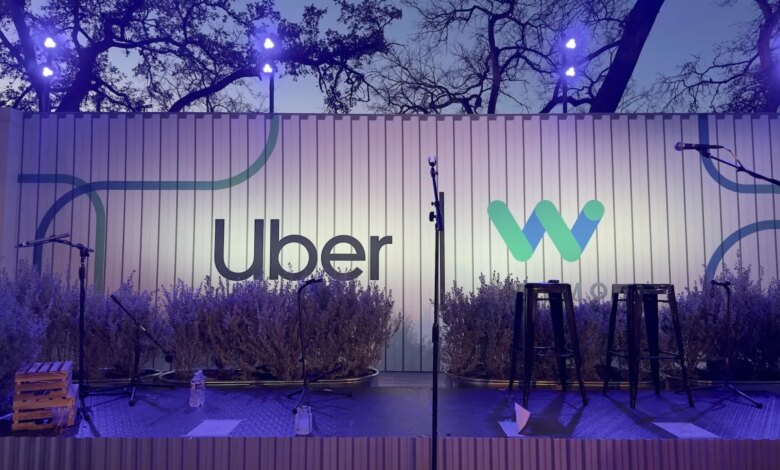
In March 2025, the two companies seemed to solidify their alliance during an event celebrating the launch of Waymo robotaxis in Austin through the Uber platform. This partnership expanded to Atlanta, though customers can only access robotaxis via the Uber app, not Waymo’s own app.
However, recently, tensions have surfaced between the two companies.
Uber’s chief technology officer publicly criticized Waymo’s robotaxi operations earlier this year, highlighting safety concerns. During a corporate meeting, the Uber CEO indirectly referenced Waymo while expressing approval for regulatory scrutiny.
This rift may even extend internationally, with both companies preparing for potential regulatory challenges in London.
While the future of their partnerships remains uncertain, both companies are gearing up for a regulatory showdown that could have far-reaching implications.
Uber is promoting a vision for a hybrid future divergent from Waymo’s perspective.
“We believe the future transportation system will integrate both human-driven and autonomous vehicles,” noted Uber’s AV policy chief ahead of the pending legislative hearing. “Public policy should reflect this reality rather than solely favoring an AV-only future that isn’t feasible.”