Robotic Firm Resolves Tesla Trade Secret Dispute and Unveils $11M Funding Boost

Jay Li doesn’t suggest provoking legal issues with Tesla when launching a startup, but he believes his company, Proception, has come out stronger from the ordeal.
“It’s like a test of resilience,” he shared in an exclusive conversation. “There’s a saying that what doesn’t kill you makes you stronger, right?”
Li, formerly a technical lead in Tesla’s Optimus humanoid robot initiative, faced accusations from the automaker last year for allegedly stealing trade secrets to establish Proception. After several months of legal disputes, he recently settled, resulting in Tesla dropping the lawsuit. (Tesla has not provided any comments on the matter.)
With the lawsuit behind him, Li now aims to address a more formidable challenge: enabling robotic hands to function like those of humans.
On Monday, Proception announced the successful completion of an $11 million seed funding round, led by First Round Capital, with backing from Y Combinator and BoxGroup.
In conjunction with this announcement, Proception revealed it is dispatching its initial set of “high-dexterity robotic hands” to researchers and companies in the robotics sector, while also accepting broader orders. Li’s ambition is to become the leading supplier of robotic hands for firms that prefer not to invest in developing complex “dextrous manipulation” systems on their own.
Despite a surge of investment and interest in robotics recently, Li argues that insufficient resources have been dedicated to engineering robotic hands that closely resemble human hands.
One prominent figure commenting on this obstacle has been Tesla’s CEO Elon Musk, who claims that achieving human-like dexterity in robot hands remains one of the toughest engineering challenges. While Musk believes Optimus robots could soon be operational in factories, experts generally agree that replicating human hand functions is still years away. Kevin Lynch, director of Northwestern University’s Center for Robotics and Biosystems, has estimated that it will take about a decade for robots to become “functional and useful in performing human-like tasks.”
Li is optimistic about Proception’s ability to achieve this feat more swiftly, primarily due to their data collection methods.
Currently, many companies training humanoid robots rely on teleoperators, where a human wearing a virtual reality device sees and manipulates what the robot encounters. However, Li points out significant drawbacks to this technique, including the lack of tactile feedback from the objects that robots engage with and limitations based on the number of available robots.
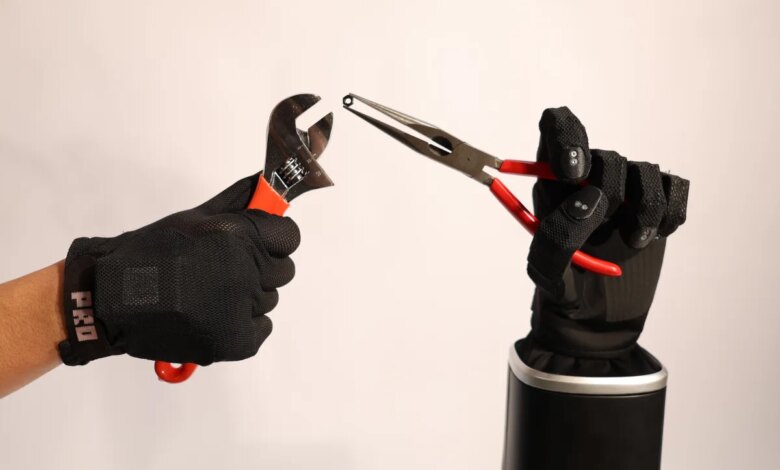
Proception’s innovative approach involves a sensor-laden glove worn by human testers. This method allows the company and its clients to collect vital “human hand interaction data” without needing any robotic involvement, according to their recent press release.
The same glove serves as the sensor-equipped “skin” for the robotic hand Proception is developing, which boasts 22 degrees of freedom and multiple joints per finger to facilitate a wide array of dexterous movements.
Li explained that this technique enables Proception and its collaborators to gather detailed, task-specific data, thus allowing the robotic hands to more accurately mimic human functionality. He believes this method is well-suited for scalability.
“You need both hardware and data, which must develop together for dexterous manipulation to succeed. Many firms focus only on hardware or rely on non-scalable data collection,” he said. “We’re creating highly dexterous hardware alongside scalable data, and we believe that’s essential to solving this challenge.”
First Round partner Bill Trenchard highlighted this aspect as a key reason for investing in Proception.
“We’re confident they will produce the best hand on the market, perhaps the most advanced one available today, paired with the data and models to support it,” he remarked. “Dexterous manipulation is crucial for advancing humanoid robotics, and many believe it’s the final hurdle in achieving functional robots.”
Trenchard also commended Li’s ability to remain composed during his legal battle with Tesla.
“He was transparent with us regarding the lawsuit, and the team managed to keep their focus,” Trenchard stated. “Jay is an exceptional leader.”
Li expressed confidence in the future. Despite confronting Tesla’s formidable legal team, he suggested it wouldn’t be unusual for the corporation to seek assistance from Proception as it expands.
“I think it will eventually happen,” he concluded.