Startup Aims to Revolutionize Robotaxi Maintenance by Reducing Travel for Cleaning and Charging

As you wander through San Francisco, it’s common to encounter empty autonomous vehicles navigating the streets, either awaiting a passenger or returning to a facility for maintenance. These journeys without passengers, known as deadhead miles, present significant challenges to the profitability of robotaxi services.
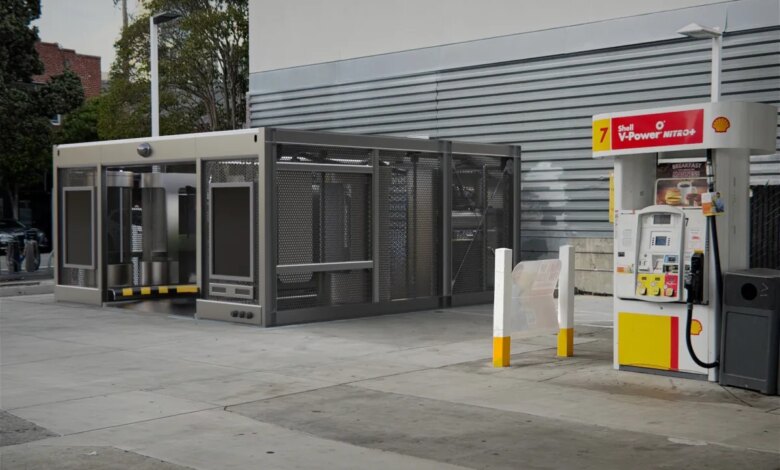
To address this issue, Aseon Labs, a startup based in Redwood City, California, has introduced an innovative solution: space-efficient automated pods designed to be placed throughout urban areas, allowing for the inspection, cleaning, and charging of robotaxis. Co-founded by the creators of battery-swapping startup Pushme, Aseon Labs refers to these as robotic pit stops, a concept that has piqued investor interest.
Recently, Aseon Labs successfully raised $10 million in seed funding, spearheaded by Crane Venture Partners. Additionally, contributions came from Y Combinator, Expa (the venture firm of Uber co-founder Garrett Camp), Robin Hood Ventures, and Founders Capital, alongside several notable angel investors including former Google executive Adrian Aoun and Zimride co-founder Rajat Suri.
In its infancy, Aseon Labs intends to allocate these seed funds toward developing five prototypes of the pods, increasing its current team from six to a projected twelve, and acquiring properties necessary for expanding its network, as stated by co-founder and CEO George Kalligeros.
Kalligeros emphasized the need for increased utilization to achieve economic viability within the ride-hailing sector. “For self-driving vehicles to be financially sustainable, they need to run continuously throughout the day’s demand curve,” he explained.
The company’s proposal suggests that a network of distributed autonomous pods could significantly reduce deadhead miles, transforming robotaxi services into profitable ventures.
Both Kalligeros and COO Dan Keene come from backgrounds that provide them with the expertise necessary for hardware and real estate ventures. Kalligeros previously worked as a mechanical design engineer at brands like Bentley Motors and Tesla before co-founding Pushme, which focused on creating battery-swapping networks for micromobility solutions. Pushme successfully established its presence in Europe before being acquired by Tier Mobility in early 2020.
Kalligeros explained that their previous endeavor involved deploying infrastructure across multiple markets quickly, emphasizing the importance of strategic location selection for efficiency.
Aseon Labs applies similar logic to autonomous vehicles. In their exploration of the industry, they observed existing AV depots where robotaxis are serviced. The high cost of real estate often pushes these facilities away from city centers, where demand is highest.
“The infrastructure in AV depots is crucial for launching a new city for any operator,” Kalligeros noted. “However, the current operational processes involved are not fully optimized.”
The founders envision creating smaller, independently powered pods that can be distributed across urban areas and easily relocated if performance dips. These units will be equipped with cameras to inspect vehicles and robotic arms for cleaning and retrieving lost items, while also being classified as temporary structures to bypass lengthy permitting processes.
The pods can operate using portable energy sources like propane or connect to established power lines via arrangements with electric vehicle charging partners. Initially, they will be staffed, moving toward full autonomy as technology advances.
Aseon Labs will not attempt to solve every possible issue; instead, they will leverage AI and computer vision to identify challenges. For instance, should they detect a stain like melted chocolate, the robotic arm will refrain from intervening to avoid exacerbating the problem, directing the vehicle back to a main depot for human assistance instead.
Although Aseon Labs has yet to secure contracts with any robotaxi providers, Kalligeros noted that interest in their concept is widespread. “Almost everyone is eager to give it a try,” he remarked.