India’s Airbound Secures $37 Million to Challenge Truck Transport with High-Speed Drones

Airbound, an Indian startup specializing in autonomous drones, has secured $37 million in new funding to strive for cost-effective aerial delivery comparable to road transportation.
The Series A funding round, led by Greenoaks and featuring contributions from DoorDash, Lachy Groom, Lightspeed, and Humba Ventures, follows a recent seed round of $8.65 million raised less than a year ago. Over its three years of operation, Airbound has accumulated nearly $50 million in total funding.
Advocates of drone technology, including Airbound and other emerging companies in the sector, believe that drones can deliver specific items more swiftly and economically than ground vehicles. Despite successful implementations, the current scale and versatility of drone delivery systems still trail far behind this conventional transportation method.
To bridge this gap, Airbound is reengineering its drones to enhance their competitiveness against traditional transport options.
Typical aircraft consume considerable energy to support their own weight rather than maximizing payload capacity, resulting in high operational costs, especially for lighter loads. According to Naman Pushp, founder and CEO, Airbound’s solution involves creating vertical-flight drones that weigh less than the cargo they transport.
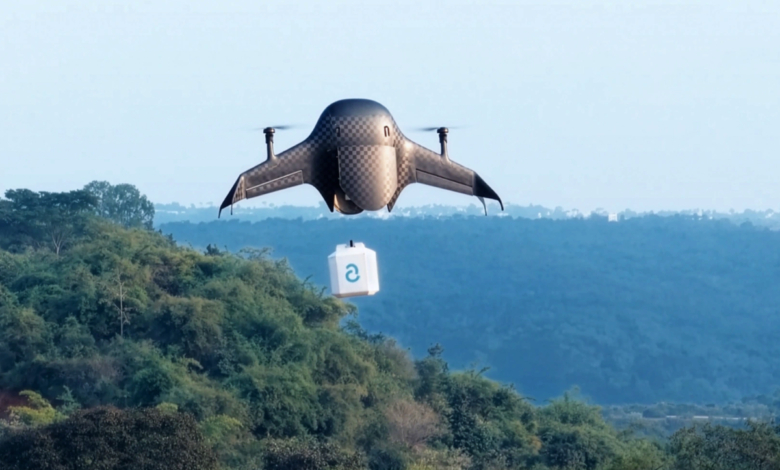
The startup’s present drone model, known as TRT, weighs approximately 3.3 pounds, with a cargo capacity of about 2.2 pounds. The upcoming iteration, currently being developed, is projected to weigh around 6.6 pounds and support payloads up to 11 pounds, Pushp stated during an interview.
Employing a unique tail-sitter design that allows vertical takeoff and landing, Airbound’s drones stand upright during landing and takeoff before transitioning to horizontal flight. Pushp emphasized the company’s aim to maintain this vertical capability even as they develop larger drone models to avoid needing runways.
“Our vision is to achieve cost parity with trucking for aerial deliveries,” he stated.
Established in 2023, Airbound has successfully completed over 13,000 autonomous flights in southern India, specifically in Bengaluru and Guntur. This includes more than 1,000 flights in partnership with Narayana Health, a hospital network that utilizes its drones to transport diagnostic samples between facilities.
Currently, one drone operates along the Narayana route, facilitating the transport of diagnostic materials roughly 2.5 miles in about seven minutes. In contrast, transporting these samples via two-wheelers can take three to five hours, mainly due to delays in collecting enough samples for bulk transport, according to Pushp.
This collaboration is set to expand to Narayana’s new Banashankari hospital in Bengaluru, which lacks an on-site diagnostic lab and blood bank, relying instead on Airbound’s delivery system to connect with centralized services.
A Three-City Drone Delivery Network
Airbound aims to develop a more ambitious drone delivery network that links three cities in Andhra Pradesh. The startup signed an agreement with the state government, targeting an eventual goal of 10,000 daily flights for retail, e-commerce, and healthcare purposes. The number of drones required for this operation could range from 250 to 1,000, depending on the lengths of the routes, although Pushp anticipates the need for around 250 aircraft.
This agreement does not involve any government funding or contracts, according to Pushp, who noted that the Andhra Pradesh government is assisting Airbound with the regulatory framework necessary for the network. The startup anticipates generating revenue from partnered companies utilizing the delivery service.
Various Indian startups, such as Skye Air Mobility and TSAW Drones, are also developing their aerial logistics businesses, with other manufacturers like Garuda Aerospace exploring similar delivery applications. However, Pushp contends that Airbound’s focus is on creating aircraft that can be utilized by various logistics networks rather than merely aiming to be the most extensive delivery operator.
“Our goal is to assume the role of a manufacturer like Boeing, providing the aircraft that logistics companies rely on, rather than operating as an airline,” he explained.
The company designs and constructs its drones in a substantial 43,000-square-foot facility in Bengaluru, maintaining control over the airframe and other critical systems in-house. While Pushp refrained from revealing specific production capabilities or the total number of aircraft constructed thus far, he assured that scaling up manufacturing would not be a limiting factor for Airbound.
Instead, Pushp identified regulatory hurdles, particularly obtaining licenses for beyond visual line of sight (BVLOS) operations, as the more significant challenge. This certification is essential for operating large-scale delivery networks effectively.
These regulatory challenges have also constricted Airbound’s ability to transform its flights into substantial commercial revenue. The startup remains largely without revenue despite employing over 150 individuals.
“Our aspiration is to become a major player in the industry over the next few decades, rather than focusing on immediate revenue generation,” Pushp stated.