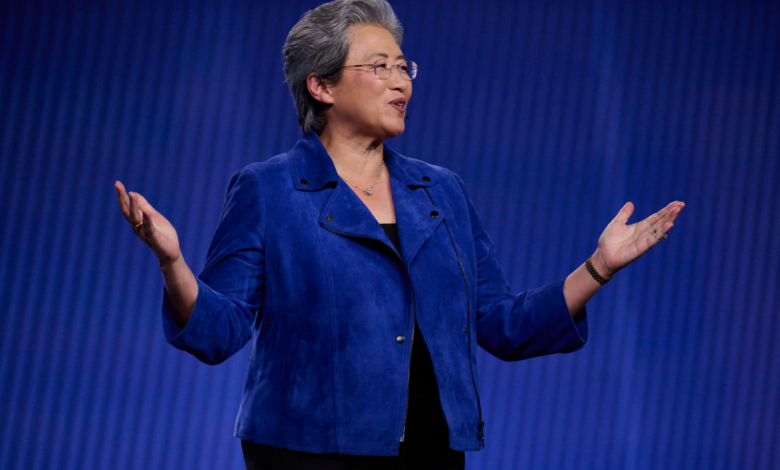
AMD, the chip manufacturer, is challenging Nvidia with its latest introduction: a powerful rack-scale system aimed at fulfilling the computing requirements of major AI laboratories across the globe.
During the recent Advancing AI conference in San Francisco, which saw a full house, AMD’s Chair and CEO Dr. Lisa Su unveiled the new AI rack system named Helios. She highlighted its expanding client base, which includes Microsoft, as the company gears up for its launch later this year. Su also presented the latest chips specifically engineered to meet the increasing demands of the AI sector.
Rack systems are designed to combine multiple processors into one powerful setup. These units are ideal for data centers, where they facilitate the training and operation of AI models and other demanding computational tasks.
Dr. Su emphasized that Helios is the industry’s most advanced AI rack, engineered to handle the most rigorous frontier models on a grand scale. According to the company, this system will be utilized by top AI firms operating at gigawatt levels.
Historically, Nvidia has led this segment with its Vera Rubin and Grace Blackwell rack-scale systems. AMD appears to be positioning itself to compete, and early performance data of Helios suggests it may outpace Vera Rubin in several important areas.
First introduced in 2025 and showcased at CES 2026, Helios is already attracting notable clients such as OpenAI, Meta, Oracle, Anthropic, and Microsoft, all of whom intend to implement the system. Microsoft CEO Satya Nadella announced plans to enhance Azure infrastructure with Helios. Additionally, AMD and Anthropic entered into a strategic partnership to deploy as much as two gigawatts of GPUs using this new rack system.
On the same day, AMD revealed its Venice-X CPU, crafted for data centers to manage intensive computing tasks, with an expected launch in 2027.
Dr. Su also discussed the trajectory of the chip industry, projecting that by 2030, chips supporting AI will account for a significant portion of the overall computing market. She noted that this growth is due to a substantial increase in compute demand, primarily fueled by the emergence of agentic AI.
“When an agent is tasked with a job, it must perform numerous steps, reason through the process, call upon tools, access data, and repeat these actions until a solution emerges, which necessitates a multitude of GPUs,” she explained.
“We anticipate that by 2030, the AI accelerator market will reach approximately $1.4 trillion,” Su stated. “This forecast suggests that by the end of the decade, the AI accelerator market could rival the current size of the entire semiconductor market.”
“We believe that GPUs will represent the bulk of this market because the algorithms are still evolving, and we are witnessing continual changes in workloads that favor programmability across the broader silicon ecosystem,” she concluded.