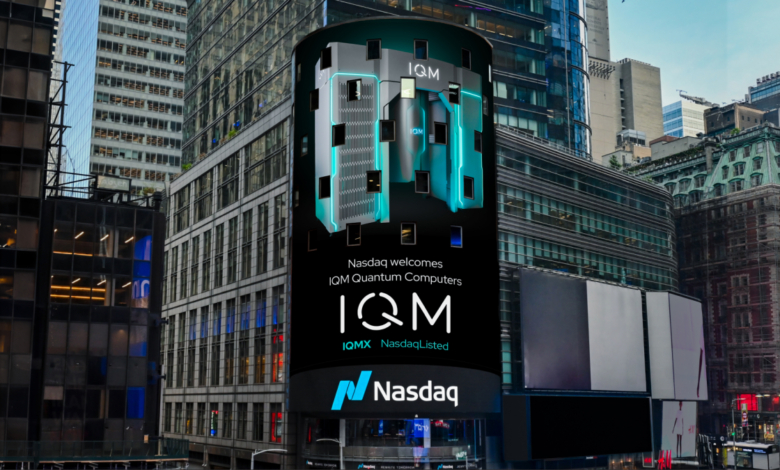
IQM, a Finnish quantum technology company, made its debut on the Nasdaq on Thursday through a SPAC merger, achieving a valuation of approximately $1.9 billion. However, the company’s stock did not see a surge and largely remained below the initial offering price, signaling a tepid reception.
Recently, SPAC mergers have not generated significant enthusiasm among retail investors. In IQM’s case, this relative disinterest may stem from the company’s own acknowledgment in its prospectus that “large-scale commercial traction of quantum computing technology may never occur.”
This cautionary note is applicable to the entire quantum sector. Nonetheless, that hasn’t hindered IQM and its competitors from gaining customers who currently employ the technology for simulation and optimization tasks. IQM offers both physical quantum computers and cloud services, catering to clients such as VTT Technical Research Centre of Finland and the Leibniz Supercomputing Centre in Germany.
Jan Goetz, CEO and co-founder of IQM, shared with TechCrunch, “We supply computers to advanced supercomputing facilities and data centers, and we provide computing time via the cloud.”
The company’s client base has expanded from eight to 22 within a single year, marking a noteworthy achievement, particularly with the addition of two corporate clients. However, this growth highlights that broader demand may not materialize until the “quantum advantage” — a point when quantum chips surpass traditional computers in a wide range of complex tasks, creating profound impacts in sectors from biotechnology to finance.
Yet, even within the industry, no one can predict when this breakthrough might occur.
Despite this uncertainty, investor interest in both public and private quantum firms continues to rise, partly spurred by recent executive directives from President Trump aimed at accelerating advancements in quantum technology. In response, the U.S. Department of Energy has pledged to deliver “the world’s first fault-tolerant, scientifically relevant quantum computer” by 2028.
This initiative aligns with similar announcements from other nations including France, Germany, and the U.K. However, Trump’s orders particularly benefit IQM, which has set up a quantum tech center in Maryland and installed a computer at Oak Ridge National Laboratory, part of the Department of Energy. Goetz remarked, “We can directly benefit from it.”
Distinct from other European unicorns, IQM is not relocating its primary operations to the U.S. Instead, it plans to trade on Nasdaq Helsinki as well as its IQMX ticker in the U.S., anticipating ongoing backing from entities like Tesi, Finland’s sovereign wealth fund.
IQM’s origins are closely intertwined with Finland, having been established in 2018 as a spin-off from Aalto University in Espoo, a technology and quantum center close to Helsinki, where a significant portion of its workforce continues to be based. The company has also grown to include around one hundred team members in Munich, with others in various locations supporting its global expansion strategy.
In its prospectus, IQM highlighted that this dual presence was appealing to RAAQ, the blank check firm that facilitated IQM’s SPAC route to public trading. “As demonstrated by over €200 million in public support for IQM, European governments and enterprises have backed IQM’s rise as a leading quantum computing entity in Europe while also showcasing its capability to operate internationally,” stated the RAAQ board.
Goetz expressed pride in IQM’s achievement as the first European quantum company to list in the U.S., especially given the simultaneous announcement from the French competitor Pasqal regarding its own SPAC plans. “It’s gratifying to be first and a trailblazer, but ultimately the goal is long-term success,” he commented.
This operation is set to generate around €198 million after expenses, equivalent to $226 million. Notably, IQM had previously raised $300 million last September. “It’s a significant accomplishment to raise funds so soon after our Series B round,” Goetz noted, emphasizing that IQM’s primary objective was to enhance its visibility in a competitive field full of uncertainties.